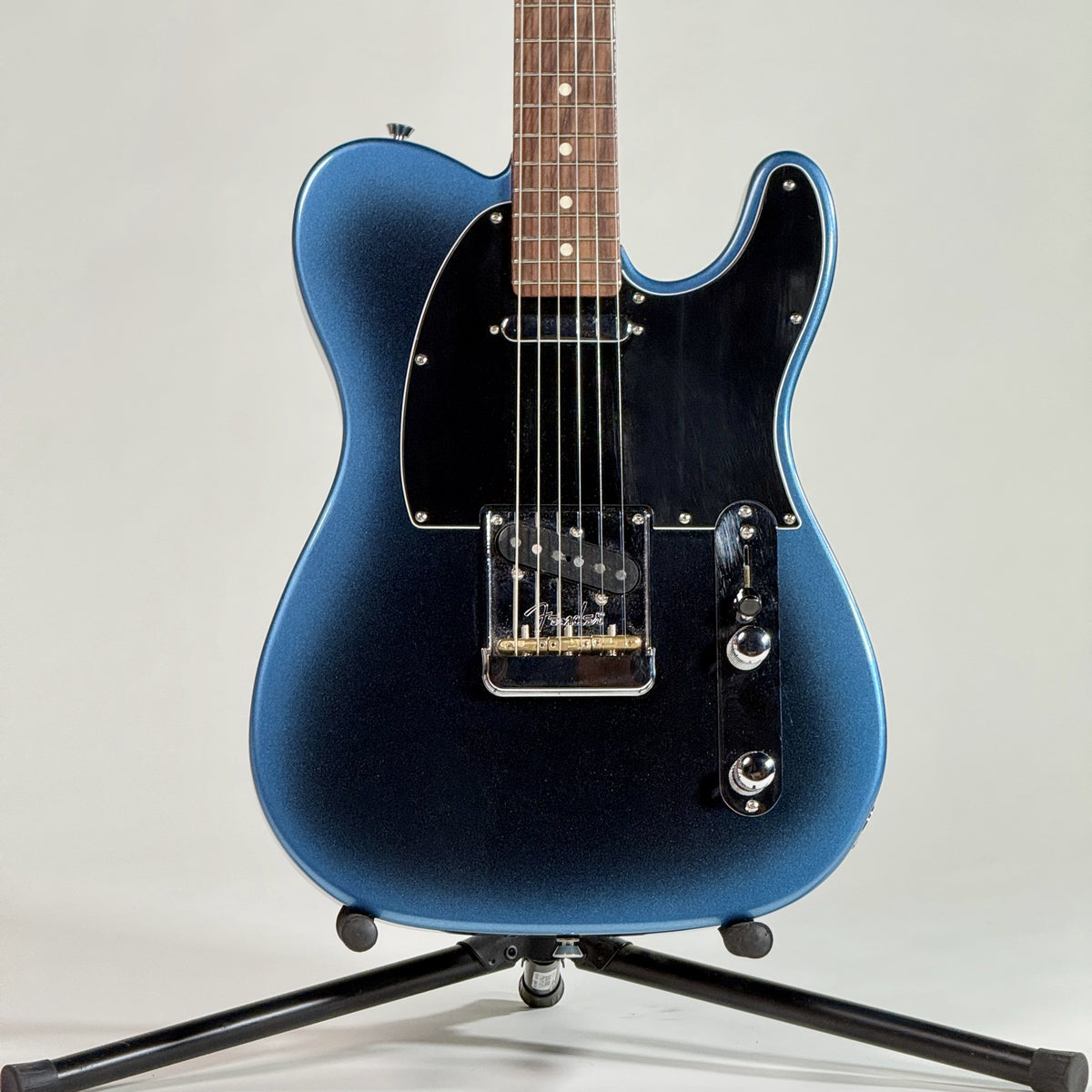
Finish. We went over the front, the back and both edges and could not find a ding, a chip, a scratch through the clear coat or a buckle mark. The back of the body is the place that matters most on a Telecaster, because there is no rear contour and a strap buckle shows up there before anywhere else, and it is clean right across. Both edges are clean and still glossy.
Frets and board. The frets are full. The crowns are unmarked under the string paths from the first position up, which is where a player wears them first. The rosewood shows no finger grooving and no build up in the slots. The nut is clean, with no chipping at the slots.
Neck. The satin back of the neck has no polish through behind the first three frets, which is the other place a played guitar gives itself away. The maple is unmarked front and back.
Pickguard and control plate. This is the one thing worth naming. Under strong light at an angle there is fine surface swirl on the black pickguard between the bridge pickup and the control plate, the kind a pick leaves on any gloss guard, and the control plate shows the same sort of fine polishing marks. Neither shows at normal exposure and neither is damage.
Hardware. Bright throughout. No pitting on the bridge plate, the three brass saddles, the tuner housings, the string ferrules, the jack cup or the neck plate. The Fender script on the bridge plate is crisp, and the serial number and the 75th anniversary logo on the back of the headstock are sharp.
Electronics. We have played it. It plays and the controls work.
Strings. The strings on it now are played strings, not fresh.
Case. The Fender molded case has been photographed closed and is undamaged on the outside.