




Grace Design Spacebar
Stereo bars and microphone trees with the spacing and angle marked on them, so a setup goes back where it was.

The bar
A ruler marked every 5 mm runs along it. On the 30 cm bar two holders sit 7 to 26 cm apart, on the 66 cm bar 7 to 61 cm, and either bar fits the same clamp.
The clamp
It threads onto a 5/8-27 mic stand and tilts the whole bar, with a scale on its side from 90 degrees down to 90 up. A threaded stud longer than 7/16 inch can stop the bar turning, so check your stand.
The mic thread
Your mic clip threads onto a 5/8-27 boss, or the 3/8-16 thread European clips use, and a jam nut locks it so it can't turn. The kit's holders also turn on a scale marked every 5 degrees.
A mic bar with the numbers on it
Put two microphones in front of the same sound and how wide it comes back depends on two numbers: how far apart the capsules are and the angle between them. Change either and the picture between your speakers gets wider or narrower.
The Spacebar is machined from aluminum, brass and stainless steel, and it carries both numbers. The stereo bar has a ruler marked every 5 mm and each holder turns on a scale marked every 5 degrees. The modular tubes carry centimeter scales, and the adjustable holders that clamp to them have the same 5 degree marks. Write the numbers down and next session the array goes back where it was.
The scale shows where the holder is, not where the capsule is, and that depends on the mic and its clip. Measure the capsule spacing with a tape the first time, then note where the holders sit.
If you set up one XY pair and never touch it, any stereo bar will hold it. This is for when the setup changes from session to session and you want last week's back.
Pick the array
Each one is a way of placing the mics, with the kit that sets it up and the number of preamp channels it needs.

XY and ORTF
Two directional mics on one stand, angled apart. XY puts the two capsules together, and ORTF spaces them 17 cm apart at 110 degrees. The 30 cm bar does both: it sets its holders 7 to 26 cm apart, and for XY the kit's tall holder lifts one mic over the other.
What to buy: the stereo kit with the 30 cm bar. Two preamp channels.

Spaced pairs
Two mics set apart. An AB pair is usually two omnis, and NOS is two directional mics 30 cm apart at 90 degrees. The 66 cm bar reaches 61 cm, room for NOS and a 50 cm AB pair.
What to buy: the stereo kit with the 66 cm bar. Two preamp channels. For wider than 61 cm, Grace makes a 1 m AB bar that a second tube takes to 2 m: ask us.

Blumlein
Two figure-8 mics, one above the other on the same vertical axis, crossed at a precise 90 degrees. Alan Blumlein worked it out in the 1930s. The whole upright tilts, so the pair can aim down at an ensemble from a tall stand.
What to buy: the Blumlein kit, which takes most figure-8 mics in their own clips and comes with its own right angle stand mount. Two preamp channels. For RCA 44 and 77 style ribbons Grace makes a version with two right angle holders on a longer 80 cm tube: ask us about that one.

Decca Tree
Three mics in a T, left and right 2 m apart and the center one 1 m forward. Decca Records engineers developed it in the 1950s.
What to buy: the Decca Tree, with the regular stand mount for a mic stand or the heavy duty one for a lighting stand. Three preamp channels. The mount slides along its tube, so set it at the balance point.

Surround Tree
Five mics on one stand: three across the front and a pair behind. The front left and right mics go from 6 to 102 cm apart, and every spacing and angle sets on a scale. Michael Williams' site mmad.info works through the array for your room.
What to buy: the Surround Tree, with the regular or heavy duty stand mount. Five preamp channels.
Immersive, or your own
The tubes, holders and joiners come separately, so a tree doesn't have to be one of these. Grace also builds the 2L Cube, which Morten Lindberg of 2L developed for immersive recording: eleven mics on a 1 m cube, seven on the lower level and four above.
Ask us for a price on either.


A preamp channel for every mic
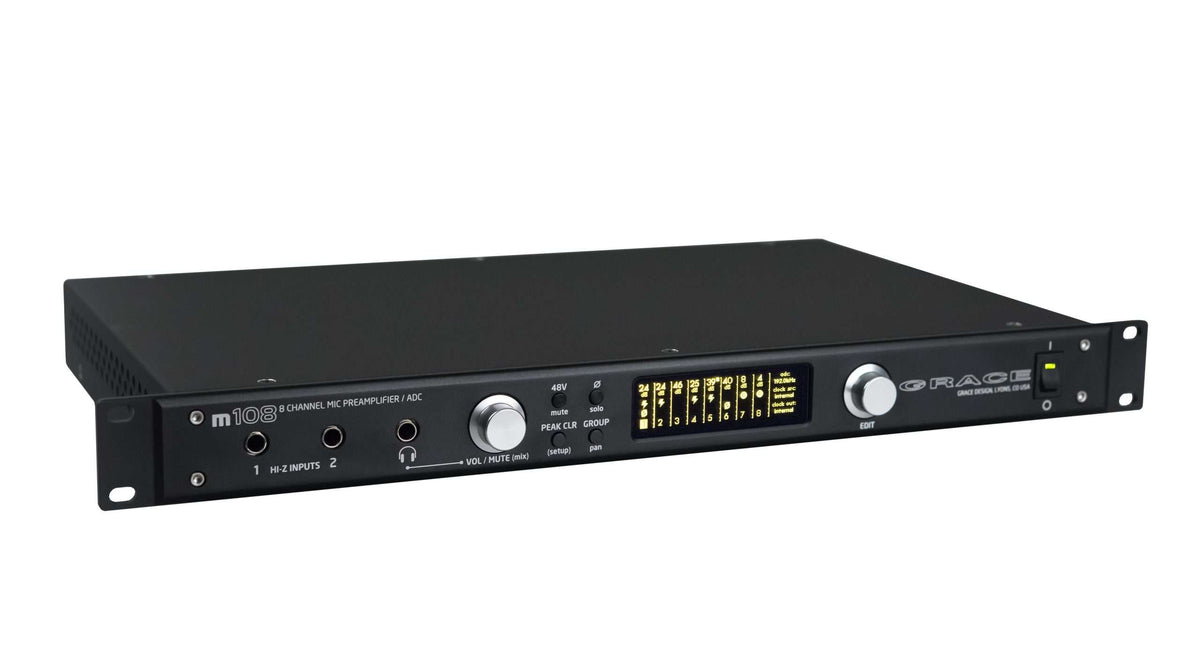
A pair needs two channels, a Decca Tree three, a Surround Tree five and the 2L Cube eleven. Grace's m201mk2 has two, and the m801mk2 and m108 have eight each, the m108 with A/D conversion built in. All three have a ribbon mode, for a Blumlein pair of ribbons.
All of Grace Design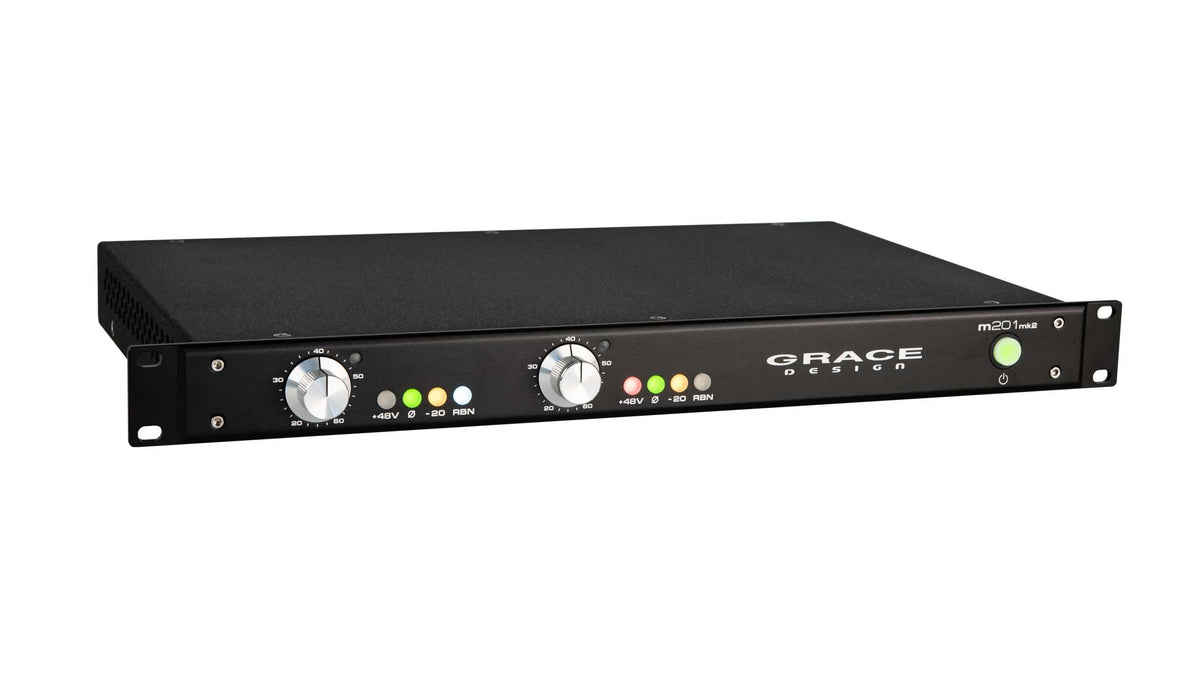



Before you order
The clamp, the bar, two holders and a tall holder, which lifts one mic above the other when their bodies would otherwise touch. The center bridge, for a third mic, and the hanging bar are separate.
Anything that sits in an ordinary mic clip. The clip threads onto the holder and a jam nut locks it so it can't turn. RCA 44 and 77 style ribbons are the exception: on the modular tubes they take Grace's right angle SB-AMHRA holder, and for a Blumlein pair of them Grace makes a version of the kit with two of those holders on a longer 80 cm tube, so ask us about that one.
Yes. Holders and the center bridge come on their own, the 30 cm and 66 cm bars fit the same clamp, and the modular tubes join end to end or at right angles, so a tree can grow a tube at a time. For a bar, tube or joiner on its own, ask us.
Grace Design's EON warranty: twenty years against defective parts and workmanship on every Spacebar product, and it transfers to whoever owns it next. Normal wear and tear, misuse and accidental damage aren't covered.
We order it from Grace when you order it. Shipping has the timing, and what happens if it runs late.
Grace recommends Michael Williams' paper The Stereophonic Zoom, on how spacing and angle set the width of a stereo recording, and his site mmad.info for surround arrays. The stereo and modular manuals have the setup steps and a parts diagram for every kit.